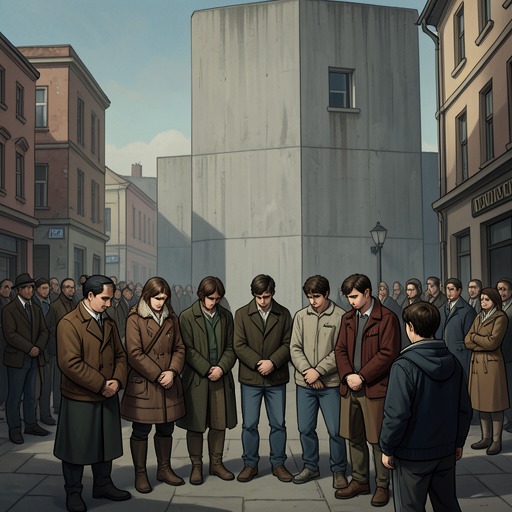
University strikes and campus lockdown
Norwegian WoodUniversity strikes and campus lockdown form a recurring test of political conviction in the narrator’s university life: the slogans promise radical change, but the strike ends in a police operation and a swift return to routine. The narrator is alienated from the outset, first welcoming the prospect of destruction as a breath of fresh air, then watching the movement’s leaders resume lectures as if its demands had never been made. The episode makes the gap between revolutionary language and action—not the success of a political program—the central fact of the campus upheaval.
The strike and the narrator’s detachment
The strike begins at the end of May, when students blockade the campus and shout for the university to be dismantled. The narrator responds inwardly with assent: he welcomes the prospect of tearing the institution apart, declares himself ready for anything, and imagines that its destruction would bring a breath of fresh air. Yet this readiness does not amount to an expressed commitment to the movement. His response grows out of personal emptiness and indifference; he does not share the organizers’ stated purpose so much as the desire to see an established order disrupted.
The narrator’s detachment is sharpened by the work he takes up while the campus is blockaded and lectures are suspended. He works for a delivery company, loading and unloading lorries five days a week, while continuing three nights a week at the record shop. The physical labor is harder than he expects, and at first he struggles to get out of bed because of the pain. But keeping his body in motion gives him a way to forget the emptiness inside. The strike, then, unfolds alongside a private routine organized around work, fatigue, books, and whisky rather than collective political action.
Police intervention and the return to routine
During the summer holidays, the university calls in riot police. They break down the barricades and arrest the students inside. The narrator treats this as part of a familiar cycle: student protests are widespread, but universities are backed by too much invested capital to dissolve simply because students have sealed off a campus. In his judgment, the protesters did not truly intend to dismantle the university. Their actual aim was to shift the balance of power within its structure, a struggle that leaves him unmoved. When the strike is crushed, he feels nothing.
In September, he returns expecting to find rubble. Instead, the campus remains intact: the library’s books are still in place, the tutors’ offices have not been destroyed, and the student affairs office has not burned down. His surprise reflects how literally he had taken the rhetoric of dismantlement, even while remaining indifferent to the movement’s internal aims. The physical continuity of the university exposes the distance between the scale of the slogans and the effects of the blockade.
The return to classes under police occupation brings a second disillusionment. The first students to take their seats are the former strike leaders. They take notes and answer when the register is called, though no declaration has formally ended the strike. The narrator confronts them and asks why they are attending lectures instead of continuing it, but they cannot give him a straight answer. Their earlier denunciations of students who opposed the strike or voiced doubts now stand against their own quick accommodation to ordinary academic demands.
Political language and institutional containment
The classroom disturbance later in the term repeats this conflict on a smaller scale. During a lecture on the deus ex machina in Euripides, two helmeted students enter: one carries political handbills, while the other tells the professor that they intend to use the remainder of the lecture for political debate. The professor doubts that the world has more urgent problems than Greek tragedy, but recognizes that the students will not listen and leaves the room. The action displaces the lecture without persuading its audience or altering the university’s underlying structure.
The handbills call for fraudulent university-president elections to be smashed, forces to be marshalled for a new all-campus strike, and the imperial-educational-industrial complex to be crushed. The narrator does not object to the positions themselves; he objects to their writing, which he finds incapable of inspiring confidence or arousing passion. He judges the speaker’s address to be no better, repeating the same old tune in different words. For him, the activists’ true enemy is not State Power but Lack of Imagination. The scene shows political language continuing after the earlier strike, but also reveals how slogans can lose force when they become formulaic.
The narrator responds to the leaders’ return by refusing to answer when his name is called on the register. He knows the gesture is pointless, yet cannot make himself participate normally. Its only immediate effect is to isolate him further: other students do not speak to him, and he does not speak to them. By the second week of September, he has concluded that university education is meaningless, but he has no goal that requires him to abandon his studies. He therefore continues attending lectures, taking notes, and using the library, recasting university as training in how to deal with boredom. The strike has not liberated him from the institution; it has intensified his withdrawal within it.
Significance
The campus conflict is presented through a sequence of reversals: a call to dismantle the university, a blockade intended to shift power within it, police removal of the barricades, and the former leaders’ return to class without a formal end to the strike. Each stage undercuts the previous one. The university’s material stability survives the occupation, while the movement’s participants resume the routines they had attacked. The narrator’s skeptical attention catches the contradiction, but his own refusal to engage politically or socially leaves him outside any alternative collective purpose.
The contrast between the mass spectacle of slogans and the small, awkward aftermath gives the episode its critical edge. Students who had condemned hesitation now accommodate themselves to attendance and grades; the narrator, in turn, makes a silent protest whose consequence is greater solitude. His perspective does not transform the campus or settle the political argument. Instead, it links the strike’s failure to his own sense of emptiness, showing how public upheaval can become another scene against which an isolated person measures his distance from other people and from the institutions around him.